



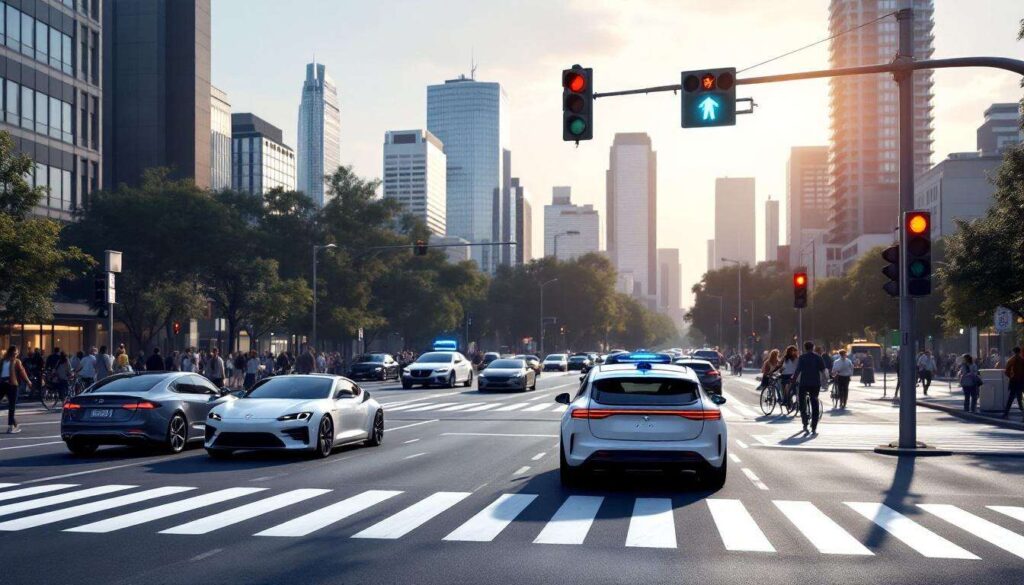
Urban roads are witnessing a profound transformation as autonomous vehicles begin to share the tarmac with traditional cars. The proliferation of robotaxis and self-driving technology demands a rethinking of how traffic management systems operate, particularly at intersections where congestion and delays remain persistent challenges. Transport engineers have proposed an innovative solution that could revolutionise the way vehicles navigate city streets: the introduction of a fourth traffic light, commonly termed the “white light”. This concept aims to bridge the gap between human-driven and autonomous vehicles, creating a more efficient and coordinated flow of traffic whilst maintaining safety standards for all road users.
The rise of robotaxis and driverless cars
Autonomous vehicle deployment across cities
The landscape of urban transportation has shifted dramatically with the deployment of robotaxis in multiple metropolitan areas. Companies operating in this sector have expanded their services beyond pilot programmes, establishing commercial operations that allow passengers to hail driverless vehicles through mobile applications. These autonomous fleets now operate in designated zones, navigating complex urban environments without human intervention.
The technology underpinning these vehicles relies on sophisticated sensors, artificial intelligence algorithms, and real-time data processing capabilities. Lidar systems, cameras, and radar work in concert to detect obstacles, pedestrians, and other vehicles, enabling safe navigation through busy streets. As this technology matures, the number of autonomous vehicles on public roads continues to increase steadily.
The growing presence of self-driving technology
Beyond commercial robotaxi services, numerous manufacturers have integrated autonomous driving features into consumer vehicles. These systems range from advanced driver assistance capabilities to higher levels of automation that allow vehicles to handle certain driving tasks independently. The adoption of such technology represents a significant shift in how society approaches personal transportation.
- Enhanced safety features reducing human error
- Improved fuel efficiency through optimised driving patterns
- Greater accessibility for individuals unable to drive
- Potential reduction in traffic accidents caused by distraction or impairment
As autonomous vehicles become more prevalent, the infrastructure that supports them must evolve accordingly. Traditional traffic management systems were designed exclusively for human drivers, creating a mismatch between current road infrastructure and the capabilities of modern autonomous technology. This growing disparity has prompted researchers and engineers to explore novel solutions that accommodate both vehicle types.
The necessity of a fourth traffic light
The white light concept explained
The proposed white light system represents a paradigm shift in traffic signal design. Unlike the familiar red, amber, and green lights that have governed intersections for over a century, this fourth signal would activate specifically when a sufficient proportion of autonomous vehicles approaches an intersection. When illuminated, the white light would indicate that autonomous vehicles are coordinating traffic flow through vehicle-to-infrastructure communication.
This system operates on the principle that autonomous vehicles can communicate with each other and with traffic infrastructure to optimise passage through intersections. When the white light activates, human drivers would receive a clear instruction: follow the autonomous vehicle ahead. This approach leverages the computational capabilities of self-driving cars whilst providing straightforward guidance to human motorists.
Addressing current infrastructure limitations
Existing traffic signals function on predetermined timing sequences or basic sensor triggers that cannot account for the unique capabilities of autonomous vehicles. These systems treat all vehicles identically, failing to capitalise on the coordination potential that connected autonomous vehicles offer. The introduction of a fourth light addresses this limitation by creating a dedicated phase for autonomous vehicle coordination.
| Traffic Signal Type | Primary Function | Vehicle Communication |
|---|---|---|
| Traditional three-light | Fixed timing sequences | None |
| Adaptive signals | Sensor-based adjustments | Limited |
| Four-light system | AV coordination phase | Full integration |
The white light serves as a visual indicator that a different traffic management protocol is in effect, reducing confusion and ensuring that all road users understand how to proceed. This clarity becomes essential as the proportion of autonomous vehicles continues to grow, necessitating infrastructure that can accommodate mixed traffic scenarios effectively.
The benefits for traffic and flow
Quantifiable improvements in travel times
Computer simulations have demonstrated measurable reductions in travel delays when the white light system is implemented. Research indicates that even modest penetration rates of autonomous vehicles yield significant benefits. With just 10% of vehicles at an intersection being autonomous, delays decrease by approximately 3%. As the proportion increases to 30%, the reduction in delays reaches 10.7%.
These improvements stem from the ability of autonomous vehicles to maintain optimal spacing, accelerate and decelerate in coordinated patterns, and eliminate the reaction time delays inherent in human driving. When multiple autonomous vehicles approach an intersection simultaneously, they can collectively optimise their movements to minimise waiting time and maximise throughput.
Enhanced coordination between vehicles
The white light system facilitates a level of coordination impossible with traditional traffic signals. Autonomous vehicles equipped with vehicle-to-vehicle and vehicle-to-infrastructure communication can share real-time data about their speed, position, and intended trajectory. This information exchange allows for:
- Synchronised acceleration patterns reducing stop-and-go traffic
- Optimised gap acceptance when merging or crossing intersections
- Predictive adjustments based on approaching traffic conditions
- Reduced fuel consumption through smoother traffic flow
Human drivers benefit from this coordination by receiving clear guidance through the white light signal. Rather than attempting to predict traffic patterns independently, they can simply follow the autonomous vehicle ahead, knowing that the system is managing flow efficiently. This approach reduces cognitive load for human drivers whilst maintaining safety standards.
The views of experts and researchers
Academic perspectives on traffic innovation
Transportation engineers from leading research institutions have championed the mobile control paradigm as a necessary evolution in traffic management. Their research emphasises that traditional fixed-timing signals cannot adequately serve a mixed fleet of human-driven and autonomous vehicles. The white light concept emerged from extensive modelling and simulation work that explored various scenarios of autonomous vehicle penetration rates.
Experts in the field argue that infrastructure adaptation must occur proactively rather than reactively. Waiting until autonomous vehicles dominate roads before implementing supportive infrastructure would result in years of suboptimal traffic conditions. Early adoption of systems like the fourth traffic light allows for gradual integration and refinement based on real-world performance data.
Industry considerations and practical applications
Beyond academic research, industry stakeholders recognise the practical necessity of infrastructure that supports autonomous vehicle capabilities. Operators of robotaxi services have noted that current traffic systems do not fully utilise the potential efficiency gains their vehicles could provide. The introduction of a coordination phase through the white light system would enable these services to operate more effectively.
Safety remains paramount in all discussions surrounding new traffic systems. Researchers stress that the white light does not eliminate existing signals but rather supplements them. Human drivers retain clear instructions at all times, whether through traditional red and green lights or through the follow-the-leader guidance provided during white light phases. This redundancy ensures that the system remains comprehensible to all road users regardless of their familiarity with autonomous technology.
The impact on urban infrastructures
Physical modifications to existing systems
Implementing a fourth traffic light requires physical upgrades to existing signal infrastructure. Traffic light assemblies would need modification to accommodate an additional lamp, whilst control systems must be enhanced to manage the new signalling phase. These changes, whilst not trivial, represent relatively modest investments compared to the potential benefits in traffic efficiency and congestion reduction.
Cities would need to prioritise intersections for upgrade based on traffic volume, autonomous vehicle penetration rates, and congestion patterns. High-traffic corridors and intersections with significant delays would likely receive priority treatment. The phased rollout approach allows municipalities to assess effectiveness and make adjustments before widespread implementation.
Integration with smart city initiatives
The white light system aligns naturally with broader smart city objectives that emphasise connectivity, efficiency, and data-driven decision-making. Many urban areas have already invested in intelligent transportation systems that collect and analyse traffic data. The fourth traffic light concept extends these capabilities by creating a direct communication channel between infrastructure and autonomous vehicles.
- Real-time traffic data collection and analysis
- Adaptive signal timing based on current conditions
- Integration with public transport coordination systems
- Enhanced emergency vehicle priority protocols
This integration creates opportunities for comprehensive traffic management strategies that optimise flow across entire networks rather than at isolated intersections. As autonomous vehicle adoption increases, the infrastructure supporting them becomes increasingly sophisticated, creating a positive feedback loop that encourages further adoption and efficiency improvements.
The challenges of implementing a new signalling system
Regulatory and standardisation hurdles
Introducing a fourth traffic light faces significant regulatory challenges as traffic signal standards are deeply entrenched in legislation and international conventions. Modifying these standards requires coordination across multiple governmental levels and jurisdictions. The process of gaining approval for such fundamental changes to traffic control systems typically involves extensive testing, public consultation, and legislative amendments.
Standardisation presents another critical challenge. For the white light system to function effectively across different regions, a universal approach to its implementation and operation must be established. Variations in how the system operates between cities or countries would create confusion for drivers and potentially compromise safety. International cooperation becomes essential to develop consistent standards that ensure interoperability.
Public acceptance and education requirements
Even with regulatory approval, the success of a fourth traffic light depends heavily on public understanding and acceptance. Drivers accustomed to the traditional three-light system for their entire lives may initially find the addition confusing or unnecessary. Comprehensive public education campaigns would be required to explain the purpose, function, and appropriate responses to the white light signal.
| Implementation Phase | Key Activities | Estimated Duration |
|---|---|---|
| Pilot testing | Limited deployment, data collection | 1-2 years |
| Public education | Awareness campaigns, driver training | Ongoing |
| Phased rollout | Gradual expansion to additional intersections | 3-5 years |
Cost considerations also factor prominently in implementation decisions. Municipalities must balance the expense of upgrading traffic infrastructure against competing budgetary priorities. Demonstrating clear return on investment through reduced congestion, improved safety, and enhanced traffic flow becomes crucial for securing necessary funding. Pilot programmes that quantify benefits provide valuable evidence to support broader deployment.
The transition to a road network that accommodates both human-driven and autonomous vehicles represents one of the most significant shifts in transportation infrastructure since the advent of motorised vehicles. The fourth traffic light concept offers a practical mechanism for managing this transition, providing clear benefits in traffic efficiency whilst maintaining safety for all road users. As autonomous vehicle technology continues to advance and deployment expands, the need for adapted infrastructure becomes increasingly urgent. The white light system stands as a forward-thinking solution that addresses current limitations whilst positioning urban transportation networks for future growth. Through careful implementation, regulatory cooperation, and public engagement, this innovation could fundamentally improve how cities manage traffic flow in an era of increasing automation.