



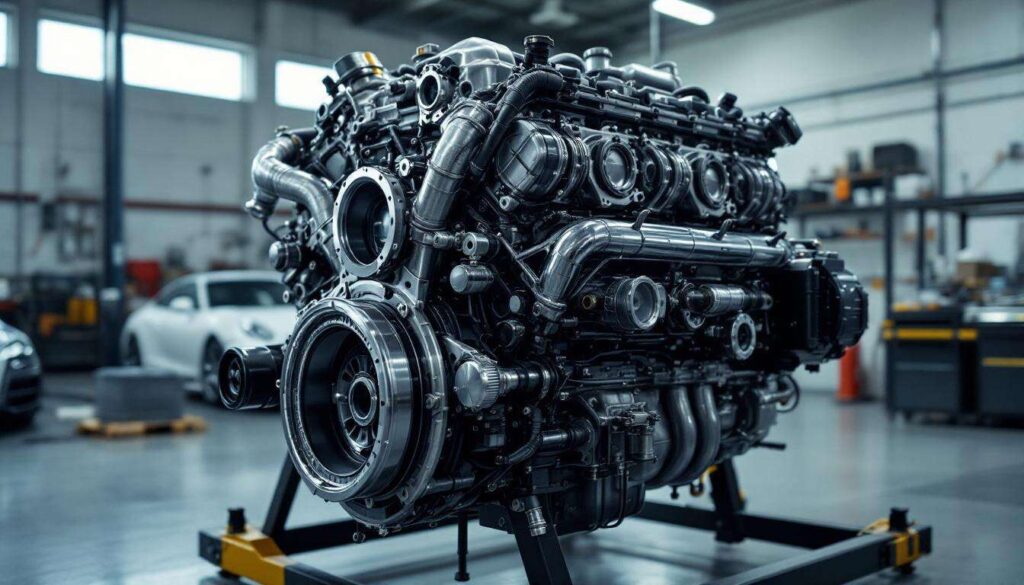
The perception of four-cylinder engines as modest powerplants suited solely for economy cars overlooks a fascinating chapter in automotive history. Throughout the decades, engineers have pushed the boundaries of displacement, creating four-cylinder units that rival or exceed the capacity of many six-cylinder engines. These mechanical marvels demonstrate that cylinder count alone does not determine an engine’s character or capability. From early racing behemoths to modern performance machines, the largest four-cylinder engines reveal ingenious solutions to vibration, balance, and power delivery challenges.
Four-cylinder engines: an unsuspected force
The engineering challenge of large displacement
Four-cylinder engines typically remain below 2.5 litres in displacement due to inherent mechanical limitations. The primary concern involves secondary vibrations that increase exponentially as bore and stroke dimensions grow. Unlike six-cylinder or eight-cylinder configurations that benefit from natural balance, four-cylinder layouts require sophisticated counter-balancing systems to achieve smooth operation at larger displacements.
Despite these challenges, several manufacturers have ventured beyond conventional boundaries. The motivations varied considerably:
- Racing regulations that restricted cylinder count whilst permitting generous displacement
- Manufacturing simplicity and reduced production costs compared to multi-cylinder alternatives
- Weight distribution advantages in sports car applications
- Reduced friction losses from fewer cylinders
Historical context and evolution
The golden era of large-displacement four-cylinder engines occurred during the early twentieth century, when racing regulations and technological limitations favoured massive single-cylinder or four-cylinder designs. Engineers prioritised raw displacement over sophisticated valve timing or forced induction, resulting in engines that could exceed 20 litres in total capacity.
| Era | Typical Displacement Range | Primary Application |
|---|---|---|
| 1900-1920 | 10-28 litres | Racing and record attempts |
| 1920-1960 | 3-6 litres | Commercial vehicles and sports cars |
| 1960-present | 2-3.2 litres | Performance cars and diesel applications |
Modern engineering has largely abandoned extreme four-cylinder displacements in favour of turbocharged smaller units, yet the legacy of these giants continues to influence contemporary design philosophy. Understanding these historical achievements provides essential context for appreciating the remarkable engines that follow.
The Porsche M44 engine: a discreet giant
Technical specifications and development
Porsche’s M44 engine represented the culmination of the manufacturer’s four-cylinder development programme, displacing 3.0 litres across its four cylinders. This naturally aspirated unit powered both the 944 S2 and the subsequent 968 model, delivering impressive performance figures that challenged contemporary six-cylinder rivals.
The engine featured several innovative technologies:
- Dual overhead camshafts with variable valve timing
- Four valves per cylinder for enhanced breathing
- Sophisticated balancing shafts to counteract vibrations
- Aluminium cylinder head with optimised combustion chambers
Performance characteristics
In the 968 application, the M44 produced 240 horsepower and delivered exceptionally linear power delivery. The engine’s considerable displacement allowed for substantial low-end torque, eliminating the need for forced induction whilst maintaining Porsche’s characteristic throttle response and mechanical refinement.
The M44’s success demonstrated that large-displacement four-cylinder engines could compete effectively in the premium sports car segment, offering unique advantages in weight distribution and packaging efficiency. This engineering philosophy would influence subsequent Porsche developments, even as the manufacturer transitioned towards smaller turbocharged units in later generations. The lessons learned from this ambitious four-cylinder project would prove invaluable when examining even more extreme examples from earlier automotive history.
Pontiac Trophy 4: american power
Origins and design philosophy
The Pontiac Trophy 4 emerged from an unconventional engineering decision: literally halving Pontiac’s 389 cubic inch V8 engine. This approach yielded a 3.2-litre four-cylinder unit that shared tooling, manufacturing processes, and many components with its eight-cylinder sibling, dramatically reducing development costs whilst creating one of America’s largest four-cylinder engines.
Introduced for compact car applications, the Trophy 4 featured:
- Cast iron construction throughout for durability
- Overhead valve configuration with pushrod actuation
- Single carburettor induction system
- Robust bottom end designed for commercial vehicle duty
Performance and application challenges
Despite its impressive 195 cubic inch displacement, the Trophy 4 struggled with the inherent vibration issues that plague large four-cylinder engines. The lack of sophisticated balancing systems meant that smoothness suffered, particularly at higher engine speeds. Power output remained modest at approximately 110 horsepower, reflecting the engine’s focus on torque delivery rather than high-revving performance.
| Specification | Value |
|---|---|
| Displacement | 3.2 litres (195 cubic inches) |
| Power output | 110-140 horsepower |
| Production period | 1961-1963 |
The Trophy 4’s brief production run highlighted the limitations of simply scaling down larger engines without addressing fundamental balance concerns. Nevertheless, it represented an important milestone in American four-cylinder development, demonstrating both the potential and pitfalls of large-displacement inline configurations. These lessons would prove particularly relevant when examining the truly colossal engines that dominated early motorsport.
The Simplex Model 90: a mechanical legend
Early twentieth century engineering
The Simplex Model 90 represented the pinnacle of pre-war American automotive engineering, featuring a massive four-cylinder engine that displaced approximately 9.8 litres. This extraordinary powerplant exemplified the “bigger is better” philosophy that dominated early luxury car development, when displacement served as the primary solution to power requirements.
The engine’s construction reflected period manufacturing capabilities:
- Individual cylinders cast separately and bolted to a common crankcase
- Side-valve configuration with minimal valve overlap
- Atmospheric induction without forced air delivery
- Massive flywheel to smooth power pulses
Performance in context
Despite its enormous displacement, the Simplex engine produced relatively modest power by modern standards, typically generating between 90 and 110 horsepower. However, torque output proved substantial, allowing these vehicles to achieve impressive performance for their era. The engine’s low compression ratio and primitive combustion chamber design limited efficiency, yet reliability remained acceptable given the leisurely operating speeds typical of period driving.
The Simplex Model 90 demonstrated that four-cylinder architecture could scale to previously unimaginable dimensions, though the resulting vibration and mechanical stress required substantial engineering compromises. These challenges would push subsequent designers towards even more extreme solutions, particularly in the realm of competitive motorsport where regulations encouraged maximum displacement within restricted cylinder counts.
The Blitzen-Benz: excess and innovation
Racing heritage and record-breaking ambitions
The Blitzen-Benz represented the ultimate expression of early racing engine development, featuring a colossal four-cylinder unit displacing 21.5 litres. Built specifically for land speed record attempts, this extraordinary machine achieved speeds exceeding 140 miles per hour, establishing records that stood for years and cementing its place in automotive history.
The engine incorporated several advanced features for its era:
- Overhead camshaft valve actuation for improved breathing
- Four valves per cylinder, revolutionary for the period
- Sophisticated lubrication system with pressurised oil delivery
- Reinforced crankshaft and connecting rods to withstand extreme stresses
Technical achievements and limitations
Power output from the Blitzen-Benz reached approximately 200 horsepower, an extraordinary figure for the era that translated to roughly 9.3 horsepower per litre. The engine’s massive displacement compensated for relatively primitive combustion efficiency, whilst the four-cylinder configuration maintained acceptable weight compared to hypothetical larger multi-cylinder alternatives.
| Characteristic | Specification |
|---|---|
| Displacement | 21.5 litres |
| Power output | Approximately 200 horsepower |
| Top speed achieved | Over 140 mph |
The Blitzen-Benz demonstrated that four-cylinder architecture could be pushed to seemingly absurd extremes when engineering focused solely on maximum performance. However, even this remarkable achievement would be surpassed by one final contender that pushed displacement boundaries beyond all reasonable limits.
Fiat S76: the beast of Turin
The ultimate four-cylinder achievement
The Fiat S76 stands as the largest four-cylinder engine ever constructed, displacing an almost incomprehensible 28.4 litres. Built to challenge land speed records and demonstrate Fiat’s engineering prowess, this behemoth featured individual cylinders larger than entire modern car engines, with each piston sweeping over seven litres of volume.
The engine’s construction required extraordinary engineering solutions:
- Massive cast iron block with individual cylinder barrels
- Chain-driven overhead camshaft operating enormous valves
- Crankshaft machined from a single steel billet
- Pressurised lubrication system with dedicated oil pump
- Water cooling system with substantial radiator capacity
Performance and legacy
The S76 generated approximately 290 horsepower, propelling the vehicle to speeds approaching 135 miles per hour. Despite its astronomical displacement, specific output remained modest at roughly 10 horsepower per litre, reflecting the technological limitations of early combustion chamber design and valve timing systems.
The engine’s physical dimensions proved equally remarkable. Each cylinder measured approximately 190 millimetres in bore with a 250-millimetre stroke, creating combustion chambers of cathedral-like proportions. The complete engine weighed over 500 kilograms, requiring substantial chassis reinforcement to accommodate both mass and vibration.
| Parameter | Value |
|---|---|
| Total displacement | 28.4 litres |
| Bore × stroke | 190 mm × 250 mm |
| Maximum power | 290 horsepower |
| Engine weight | Approximately 500 kg |
The Fiat S76 represented the absolute pinnacle of large-displacement four-cylinder development, a monument to early twentieth century engineering ambition that has never been surpassed. Its existence demonstrates that technical feasibility often exceeds practical necessity, creating machines that serve as much as statements of capability as functional transportation devices.
These five extraordinary engines illustrate the remarkable diversity of four-cylinder development across automotive history. From the refined Porsche M44 to the monstrous Fiat S76, each represents unique solutions to the challenge of extracting maximum performance from four-cylinder architecture. Whilst modern engineering has largely abandoned extreme displacement in favour of forced induction and sophisticated electronics, these mechanical giants remind us that innovation often emerges from pushing established boundaries beyond conventional wisdom. The legacy of these engines continues to influence contemporary design, proving that even seemingly outdated concepts retain valuable lessons for future development.