



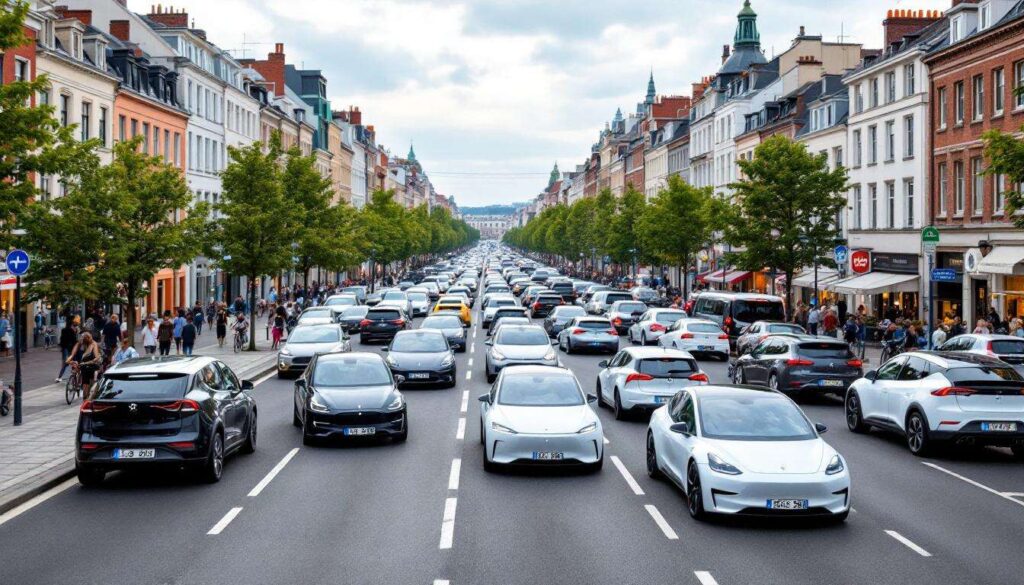
The European automotive landscape has witnessed a remarkable transformation as consumer preferences shift decisively towards cleaner mobility solutions. Recent data reveals a watershed moment that underscores the accelerating pace of this transition, with battery-powered vehicles achieving a milestone that seemed distant just a few years ago. This development reflects not only changing consumer attitudes but also the cumulative effect of regulatory frameworks, technological advances, and evolving market dynamics across the continent.
Electric vehicles surpass gasoline cars: a historic turning point
December 2025: the month that changed everything
December 2025 marked an unprecedented shift in the European car market, as electric vehicles outsold traditional gasoline cars for the first time in history. According to the European Automobile Manufacturers Association, 217,898 new electric vehicles were registered during the month, representing a 51% increase compared to December 2024. Meanwhile, standard gasoline car sales plummeted by 19% year-on-year, falling from 267,834 units to 216,492 units.
Market share evolution
The significance of this milestone becomes even clearer when examining broader market trends. Electric vehicles captured 22.6% of all car sales in December 2025, narrowly edging out gasoline cars at 22.5%. Throughout the entire year, electric vehicles achieved a market share of 17.4% in the European Union, a substantial increase from 13.6% the previous year.
| Metric | December 2024 | December 2025 | Change |
|---|---|---|---|
| Electric vehicle sales | 144,378 | 217,898 | +51% |
| Gasoline car sales | 267,834 | 216,492 | -19% |
| EV market share | 13.6% | 17.4% | +3.8pp |
Annual registration figures
Over the course of 2025, a total of 1,880,370 new electric vehicles were registered across Europe. Four key markets dominated these registrations, collectively accounting for 62% of the total. Germany led with a remarkable 43.2% increase, followed by the Netherlands with 18.1% growth, Belgium at 12.6%, and France at 12.5%.
This historic achievement signals a fundamental transformation in consumer purchasing behaviour, setting the stage for examining the underlying forces driving this remarkable change.
Economic and political factors favouring the rise of electric vehicles
Regulatory pressure and emission standards
The surge in electric vehicle adoption cannot be separated from the stringent regulatory environment that has reshaped the European automotive sector. Increasingly ambitious emission reduction targets have compelled both manufacturers and consumers to reconsider traditional combustion engines. These regulations have created a framework where electric mobility becomes not merely an option but an economic necessity.
Total cost of ownership advantages
Economic considerations have played a crucial role in shifting consumer preferences. Several factors contribute to the improving financial case for electric vehicles:
- Lower operating costs due to reduced fuel expenses
- Decreased maintenance requirements compared to combustion engines
- Favourable taxation schemes in multiple European countries
- Reduced depreciation rates as second-hand markets mature
- Access to low-emission zones in major urban centres
Energy market dynamics
The volatility of fossil fuel prices has further enhanced the appeal of electric vehicles. Consumers increasingly view electric mobility as a hedge against unpredictable petrol costs, whilst the expansion of renewable energy sources makes electric charging progressively more sustainable and economically attractive.
Understanding these economic and political drivers naturally leads to examining which market participants have benefited from this transition and which face significant challenges.
Analysis of winners and losers in this new dynamic
Manufacturers adapting successfully
Companies that invested early and substantially in electric vehicle technology have reaped considerable rewards. Manufacturers with comprehensive electric portfolios have captured growing market segments, whilst their production expertise has enabled them to scale efficiently. The four leading markets demonstrate how strategic positioning translates into tangible results, with certain manufacturers dominating specific regional markets through targeted model offerings.
Traditional manufacturers under pressure
Conversely, automotive groups that delayed their electric transition face mounting difficulties. The 19% decline in gasoline car sales represents not merely a temporary fluctuation but a structural shift that threatens traditional business models. Manufacturers heavily invested in combustion engine technology confront the challenge of retooling factories, retraining workforces, and managing the obsolescence of existing assets.
Supply chain transformations
The shift towards electric mobility has created distinct winners and losers across the supply chain:
- Battery manufacturers and raw material suppliers have experienced surging demand
- Traditional component suppliers focused on combustion engines face declining orders
- Charging infrastructure providers benefit from expanding installation requirements
- Petroleum retailers confront long-term demand erosion
Consumer segments
Among consumers, early adopters who invested in electric vehicles have benefited from improving residual values and expanding charging networks. However, those awaiting further price reductions or technological improvements may find themselves navigating an increasingly complex market with fewer traditional alternatives.
These market dynamics have been significantly shaped by deliberate policy interventions designed to accelerate the electric transition.
European policies and incentives propel the electric vehicle market
Financial incentives and purchase subsidies
Governments across Europe have deployed substantial financial incentives to encourage electric vehicle adoption. These measures include direct purchase grants, reduced value-added tax rates, and exemptions from registration fees. Such incentives have effectively narrowed the price gap between electric and conventional vehicles, making electric options accessible to broader consumer segments.
Infrastructure investment programmes
Recognising that charging availability represents a critical adoption barrier, European authorities have committed significant resources to expanding charging infrastructure. Public funding has supported the installation of charging points in urban areas, along motorways, and in rural regions, addressing range anxiety concerns that previously deterred potential buyers.
Regulatory frameworks and emission zones
Beyond incentives, regulatory measures have created compelling reasons to choose electric vehicles. Low-emission zones in major cities increasingly restrict or penalise conventional vehicles, whilst future combustion engine bans provide clear signals about the direction of policy. These frameworks create certainty for both consumers and manufacturers regarding long-term market evolution.
The cumulative effect of these policies extends far beyond sales figures, fundamentally reshaping the automotive sector and consumer experiences.
Effects on the traditional automotive sector and consumers
Manufacturing transformation challenges
The electric vehicle surge has necessitated profound changes in manufacturing processes. Traditional assembly lines designed for combustion engines require substantial modification or complete replacement. This transition demands enormous capital investment whilst simultaneously rendering existing facilities partially obsolete, creating financial strain for manufacturers managing this dual burden.
Employment implications
The shift towards electric mobility carries significant workforce implications. Electric vehicles require fewer components and different assembly skills compared to conventional cars, potentially reducing employment in certain manufacturing segments. However, new opportunities emerge in battery production, software development, and charging infrastructure installation, requiring workforce retraining and adaptation.
Consumer experience evolution
For consumers, the electric transition brings both advantages and adjustments. Benefits include lower running costs and reduced maintenance, whilst challenges involve adapting to charging routines rather than quick refuelling stops. The expanding charging network progressively addresses practical concerns, though infrastructure availability varies considerably across regions.
Dealer network adaptations
Traditional dealership models face disruption as electric vehicles require less servicing and manufacturers explore direct sales channels. This evolution challenges established retail networks to redefine their value propositions, focusing increasingly on charging solutions, software updates, and customer experience rather than routine maintenance.
These present-day transformations provide essential context for assessing what lies ahead for European electric mobility.
Future outlook for the electric vehicle market in Europe
Growth trajectory expectations
Despite achieving this historic milestone, the European Automobile Manufacturers Association emphasises that substantial growth potential remains. With electric vehicles currently representing 17.4% of annual sales, the path towards majority market share requires sustained momentum. Industry analysts anticipate continued expansion as technology improves, costs decline, and infrastructure develops further.
Technological developments on the horizon
Several technological advances promise to accelerate adoption rates:
- Enhanced battery energy density extending vehicle range
- Faster charging technologies reducing waiting times
- Declining battery costs improving price competitiveness
- Improved cold-weather performance addressing seasonal concerns
Market consolidation and competition
The electric vehicle sector appears poised for consolidation as manufacturers with insufficient scale or technological capability struggle to compete. This competitive pressure may reduce model diversity in the short term but should ultimately drive innovation and efficiency improvements benefiting consumers.
The December 2025 milestone represents far more than a statistical curiosity. It embodies the culmination of years of policy development, technological advancement, and shifting consumer preferences. The overtaking of gasoline cars by electric vehicles demonstrates that the energy transition has progressed from aspiration to market reality. Whilst challenges remain, particularly regarding infrastructure expansion and manufacturing adaptation, the trajectory appears firmly established. The four leading markets have shown that with appropriate policy support and consumer acceptance, rapid transformation is achievable. As charging networks expand and technology continues improving, the gap between electric and conventional vehicles will likely widen further. This historic turning point signals not the completion of the electric transition but rather the acceleration of a process that will fundamentally reshape European mobility in the coming years.