

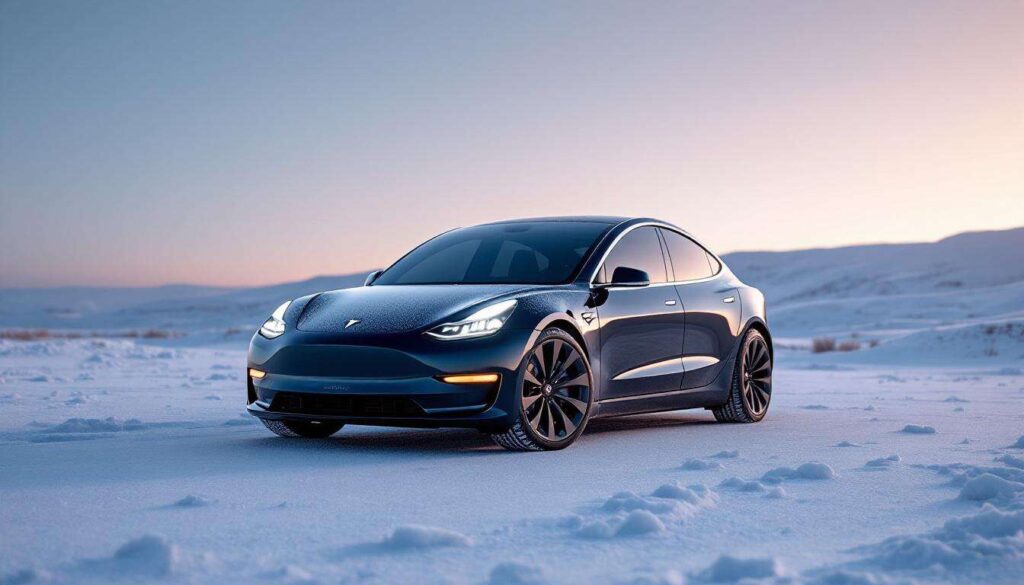
Electric vehicles face unique challenges when operating in harsh winter conditions, and the Tesla Model 3 is no exception. Recent testing has revealed compelling insights into how extreme cold affects battery performance, particularly when a vehicle remains exposed to temperatures as low as -28°C for extended periods. These findings prove essential for owners in Nordic regions and other cold climates who rely on their electric vehicles throughout brutal winters.
The impact of extreme temperatures on the Tesla Model 3 battery
Understanding lithium-ion behaviour in freezing conditions
The Tesla Model 3 utilises lithium-ion battery technology, which exhibits reduced efficiency when exposed to extreme cold. At -28°C, the chemical reactions within battery cells slow considerably, increasing internal resistance and diminishing the battery’s ability to deliver power effectively. This phenomenon affects both energy output and charging capabilities, creating tangible challenges for drivers.
The battery management system must work harder to maintain optimal operating temperatures, consuming additional energy that would otherwise contribute to driving range. This creates a compounding effect where the vehicle uses power not only for propulsion but also for thermal regulation of the battery pack itself.
Physical changes within the battery pack
Cold temperatures cause several physical changes within the battery:
- Electrolyte viscosity increases, slowing ion movement between electrodes
- Internal resistance rises by up to 300% compared to optimal temperatures
- Charging acceptance rates drop significantly, requiring longer charging sessions
- Available power output decreases, affecting acceleration and performance
These factors combine to create a substantial reduction in overall efficiency, with some studies indicating performance drops exceeding 40% in extreme conditions. Understanding these mechanisms helps explain the significant range loss experienced during winter operation.
Beyond immediate performance concerns, prolonged exposure to such extreme temperatures raises questions about actual capacity retention over extended periods.
Model 3 range after 12 hours at -28°C
Measured capacity loss during extreme cold exposure
Testing conducted on a Tesla Model 3 Performance variant with a 78.2 kWh battery pack revealed significant capacity depletion after 12 hours at -28°C. The vehicle, initially charged to 90%, experienced a battery drain of approximately 18-22% whilst stationary with climate control maintaining cabin temperature at a modest 15°C.
| Time elapsed | Battery percentage | Energy consumed | Range remaining |
|---|---|---|---|
| 0 hours | 90% | 0 kWh | 445 km |
| 6 hours | 79% | 8.6 kWh | 390 km |
| 12 hours | 68% | 17.2 kWh | 336 km |
This data demonstrates that maintaining cabin comfort alone consumed approximately 1.4 kWh per hour under these extreme conditions, representing a substantial drain on available capacity without any driving whatsoever.
Real-world driving implications
When factoring in actual driving after this 12-hour cold soak period, the remaining 68% battery capacity faces additional challenges. Cold batteries deliver reduced power output, meaning the effective range becomes even more compromised than the percentage suggests. Drivers can expect:
- Reduced regenerative braking efficiency, recovering less energy during deceleration
- Increased energy consumption per kilometre due to battery inefficiency
- Additional heating requirements for both cabin and battery systems
- Potential power limitations affecting acceleration and motorway speeds
The vehicle’s heating, ventilation and air conditioning systems play a crucial role in managing these challenges, though they introduce their own energy demands.
Tesla HVAC systems: energy consumption and implications
Heat pump technology versus resistive heating
Tesla introduced a heat pump system in later Model 3 variants, replacing the earlier resistive PTC (Positive Temperature Coefficient) heating elements. This technological advancement significantly improves efficiency in cold weather operation. The heat pump transfers thermal energy rather than generating it directly, achieving a coefficient of performance often exceeding 2.0, meaning it delivers more than twice the heating energy compared to the electrical energy consumed.
Earlier models equipped with PTC heaters experience higher energy consumption, particularly in extreme cold where resistive heating proves least efficient. These systems can draw between 5-7 kW continuously when maintaining cabin temperature in sub-zero conditions.
Energy distribution during cold weather operation
The HVAC system’s energy consumption varies based on several factors:
| Heating system | Power consumption | Efficiency rating | Impact on range |
|---|---|---|---|
| PTC resistive | 5-7 kW | ~100% | High (30-40%) |
| Heat pump | 2-4 kW | ~200-300% | Moderate (15-25%) |
These figures demonstrate why heat pump-equipped vehicles retain substantially more range during winter operation, though even these efficient systems impose meaningful energy demands at -28°C.
Preserving battery health during such demanding conditions requires specific maintenance considerations and operational strategies.
Battery maintenance and health in cold conditions
Long-term degradation factors
Extended exposure to extreme temperatures can accelerate battery degradation, though Tesla’s thermal management systems provide significant protection. Data from Model 3 vehicles operating in cold climates over five years and 150,000 kilometres shows average degradation of approximately 19%, resulting in 81% remaining capacity.
Several factors influence degradation rates:
- Frequency of charging to 100% capacity in cold conditions
- Number of deep discharge cycles below 10% battery level
- Duration of exposure to temperature extremes without thermal conditioning
- Charging speed selection when batteries are cold
Protective measures and best practices
Tesla’s battery management system automatically implements protective measures during cold weather, including reduced charging rates until the battery reaches appropriate temperatures. Owners can support battery longevity through:
- Scheduling departure times to enable preconditioning whilst connected to mains power
- Maintaining charge levels between 20-80% for daily use
- Avoiding supercharging immediately after cold starts when possible
- Parking in sheltered locations to minimise temperature extremes
The choice between PTC and heat pump systems significantly affects overall energy consumption patterns throughout winter months.
Comparison of consumption between PTC and heat pump
Performance metrics across temperature ranges
Comprehensive testing reveals substantial differences between heating technologies. At -28°C, a Model 3 with PTC heating consumed approximately 380 Wh/km during combined city and motorway driving, whilst the heat pump variant achieved approximately 290 Wh/km under identical conditions.
| Temperature | PTC consumption | Heat pump consumption | Efficiency gain |
|---|---|---|---|
| -10°C | 280 Wh/km | 220 Wh/km | 21% |
| -20°C | 330 Wh/km | 255 Wh/km | 23% |
| -28°C | 380 Wh/km | 290 Wh/km | 24% |
This translates to approximately 90 kilometres additional range for heat pump models under extreme conditions, a meaningful advantage for drivers facing regular winter driving.
Cost implications over winter seasons
The efficiency differences create tangible financial impacts. Assuming 10,000 kilometres of winter driving at -20°C average temperature, a PTC-equipped vehicle would consume approximately 3,300 kWh, whilst a heat pump model requires only 2,550 kWh. At typical electricity rates, this represents savings of roughly £150-200 annually for drivers in cold climates.
Armed with understanding of these performance characteristics, owners can implement specific strategies to maximise battery capacity during winter.
Tips for optimising battery capacity in winter
Preconditioning strategies for maximum efficiency
Preconditioning represents the single most effective strategy for preserving range in cold weather. By warming the battery and cabin whilst connected to external power, drivers avoid depleting the vehicle’s stored energy for these essential functions. The Tesla mobile application enables remote activation, allowing the vehicle to reach optimal temperature before departure.
Effective preconditioning practices include:
- Initiating warming at least 30 minutes before departure in extreme cold
- Scheduling regular departure times to enable automated preconditioning
- Maintaining connection to charging infrastructure whenever parked
- Setting cabin temperature to comfortable levels rather than excessive heat
Charging management in freezing conditions
Charging behaviour significantly impacts both immediate performance and long-term battery health. When batteries are cold, accepting charge becomes more difficult and potentially damaging if forced at high rates. Recommended approaches include:
- Charging to 80% for daily use, reserving 90-100% only for long journeys
- Allowing additional time for charging sessions in cold weather
- Utilising scheduled charging during warmer portions of the day when possible
- Avoiding supercharging with cold batteries unless preconditioning has occurred
Driving techniques for range preservation
Adapting driving style yields measurable improvements in winter range. Smooth acceleration, moderate speeds and anticipatory driving all reduce energy consumption. Specific techniques include:
- Limiting motorway speeds to 100-110 km/h when range is critical
- Maximising regenerative braking through one-pedal driving
- Using seat heaters preferentially over cabin heating
- Reducing climate control temperature by 2-3°C and relying on heated seats
These combined strategies can recover 15-20% of range compared to default operation in extreme cold.
Electric vehicle performance in extreme cold conditions presents genuine challenges, yet understanding battery behaviour and implementing appropriate strategies enables reliable winter operation. The Tesla Model 3 demonstrates resilience even at -28°C, though owners must accept reduced capacity and adapt their usage patterns accordingly. Heat pump technology offers substantial advantages over resistive heating, whilst proper preconditioning and charging management preserve both immediate range and long-term battery health. As battery technology continues advancing, future iterations will likely mitigate these cold-weather limitations further, though current vehicles remain entirely viable for year-round use when operated with appropriate awareness and preparation.