


Motorists across Britain routinely lose significant quantities of fuel without realising it, costing them hundreds of pounds annually. Research indicates that simple errors at petrol stations contribute substantially to this waste, yet most drivers remain unaware of these fuel-draining habits. Understanding these common pitfalls can transform your vehicle’s efficiency and reduce your expenditure at the forecourt.
Common mistakes drivers make at the pump
Overfilling the tank
The most prevalent error occurs when drivers attempt to top off their tanks after the automatic shut-off mechanism activates. This practice wastes fuel in multiple ways. The fuel system includes vapour recovery systems designed to capture evaporating petrol, but overfilling can saturate these components, causing fuel to leak or evaporate unnecessarily. When you continue pumping beyond the automatic stop, liquid fuel enters the vapour collection system, potentially damaging it and allowing petrol to escape as vapour.
Additional consequences of overfilling include:
- Fuel spillage onto the vehicle exterior and forecourt
- Damage to the evaporative emissions control system
- Reduced tank capacity for thermal expansion
- Potential contamination of activated charcoal canisters
Selecting the wrong nozzle position
Many drivers fail to insert the nozzle properly into the fuel tank opening. Holding the nozzle at an incorrect angle or not inserting it fully can cause fuel to splash back, resulting in wastage. The optimal technique involves inserting the nozzle completely and allowing it to rest against the tank opening, ensuring maximum fuel transfer efficiency.
These seemingly minor errors at the pump set the stage for understanding how other factors contribute to fuel waste throughout your journey.
The impact of tyre pressure on fuel consumption
The science behind rolling resistance
Whilst not immediately apparent at the petrol station, tyre pressure significantly affects fuel efficiency. Under-inflated tyres create increased rolling resistance, forcing the engine to work harder and consume more fuel. Studies demonstrate that tyres inflated to just 20% below recommended pressure can increase fuel consumption by up to 10%.
| Tyre pressure deficit | Fuel consumption increase | Annual cost (12,000 miles) |
|---|---|---|
| 10% under-inflated | 3-5% | £45-£75 |
| 20% under-inflated | 8-10% | £120-£150 |
| 30% under-inflated | 12-15% | £180-£225 |
Checking pressure at the forecourt
Petrol stations typically provide complimentary air pumps, yet fewer than 30% of drivers check their tyre pressure monthly. The recommended procedure involves checking tyres when cold, ideally before refuelling. Warm tyres from driving can give misleadingly high readings. Maintaining correct pressure not only improves fuel economy but also enhances safety and tyre longevity.
Beyond tyre maintenance, other behaviours at petrol stations directly impact fuel wastage.
Engines left running: a source of waste
Quantifying idling losses
A surprisingly common mistake involves leaving engines running whilst refuelling, which poses safety hazards and wastes fuel. Modern vehicles consume approximately 0.6 to 1.0 litres of fuel per hour whilst idling. Even a brief five-minute refuelling stop with the engine running wastes around 50-80 millilitres of petrol.
The accumulated waste from idling extends beyond the forecourt:
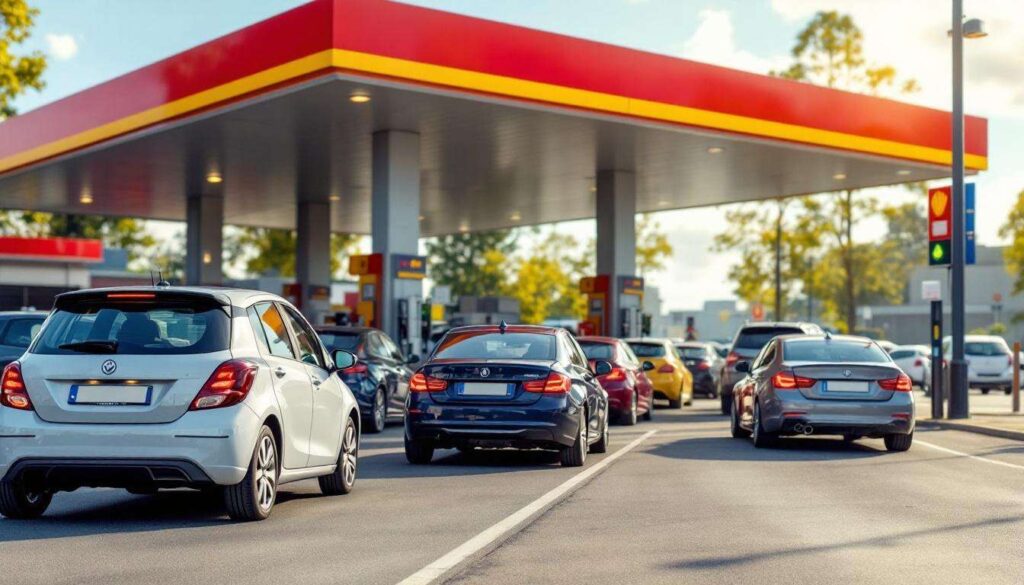
- Waiting in queues at petrol stations with engines running
- Idling whilst paying at kiosks or shop tills
- Warming up vehicles unnecessarily before departure
- Stationary periods in car parks with engines engaged
The modern engine myth
Many drivers believe that restarting engines consumes more fuel than idling, but this outdated notion applies only to carburetted vehicles. Contemporary fuel-injected engines use minimal fuel when restarting. Any stationary period exceeding 10 seconds warrants switching off the engine to conserve fuel. Start-stop technology in newer vehicles automates this process, delivering fuel savings of 5-10% in urban driving conditions.
Environmental factors at petrol stations also contribute to fuel loss in ways most motorists never consider.
The influence of heat on fuel evaporation
Temperature and volatility
Petrol is a volatile substance that evaporates readily at ambient temperatures. During summer months, fuel evaporation rates increase substantially, particularly when tanks are less than half full. The greater the empty space within the tank, the more surface area exists for evaporation to occur. This phenomenon intensifies at petrol stations where fuel caps remain open during refuelling.
Optimal refuelling timing
Fuel density varies with temperature, meaning petrol expands in heat and contracts in cold. Refuelling during cooler periods, particularly early morning or late evening, ensures you receive more fuel by volume. The difference may seem negligible per litre, but accumulated over a year, this timing strategy can save several litres. Additionally, cooler temperatures reduce evaporation during the refuelling process itself.
Recommendations for minimising heat-related losses include:
- Maintaining tanks above half full to reduce evaporation space
- Ensuring fuel caps seal properly after refuelling
- Parking in shaded areas when possible
- Refuelling during cooler parts of the day
Fuel selection represents another area where drivers inadvertently waste money and resources.
Octane rating choices: avoiding costly errors
Understanding octane requirements
A prevalent misconception suggests that higher octane fuel improves performance in all vehicles. Most standard engines are designed for 95 RON (Research Octane Number) petrol, and using premium 98 or 99 RON fuel provides no benefit whatsoever. The higher octane rating simply indicates greater resistance to engine knocking in high-compression engines, not superior energy content or cleaning properties.
When premium fuel matters
Only vehicles with high-performance or turbocharged engines specifically designed for premium fuel benefit from higher octane ratings. Using standard fuel in these engines can cause knocking and reduced efficiency. Conversely, using premium fuel in standard engines wastes approximately 10-15 pence per litre with zero performance gain. Consult your vehicle handbook to determine the appropriate octane rating for your engine.
| Engine type | Recommended octane | Annual waste (premium fuel) |
|---|---|---|
| Standard petrol | 95 RON | £120-£180 |
| Performance/turbo | 98+ RON | £0 (required) |
| Diesel | N/A | Variable |
The journey to and from petrol stations offers further opportunities for fuel conservation.
Optimising the journey to reduce fuel consumption
Route planning and station selection
Drivers frequently make unnecessary detours to reach preferred petrol stations, negating any per-litre savings through increased consumption. A two-mile detour can consume 0.1-0.15 litres of fuel, potentially exceeding savings from marginally cheaper prices. Strategic planning involves identifying conveniently located stations along regular routes rather than making special trips.
Driving style and fuel efficiency
The manner in which you drive to the petrol station significantly impacts overall fuel consumption. Aggressive acceleration, excessive speed, and harsh braking waste fuel regardless of how carefully you refuel. Implementing fuel-efficient driving techniques can reduce consumption by 15-30%:
- Maintaining steady speeds using cruise control where appropriate
- Anticipating traffic flow to minimise braking
- Accelerating smoothly and progressively
- Removing unnecessary weight and roof racks
- Combining multiple errands into single journeys
Modern technology assists drivers in optimising fuel consumption. Vehicle computers display real-time efficiency data, whilst smartphone applications identify nearby stations with competitive prices. Utilising these tools helps minimise both fuel waste and expenditure.
The cumulative effect of avoiding common petrol station mistakes, maintaining proper tyre pressure, eliminating unnecessary idling, understanding fuel evaporation, selecting appropriate octane ratings, and optimising driving habits can reduce fuel consumption by 20-30% annually. For the average British motorist covering 12,000 miles yearly, these improvements translate to savings exceeding £300 whilst reducing environmental impact. Simple awareness and minor behavioural adjustments at the forecourt and throughout your journeys deliver substantial long-term benefits for both your wallet and vehicle performance.