


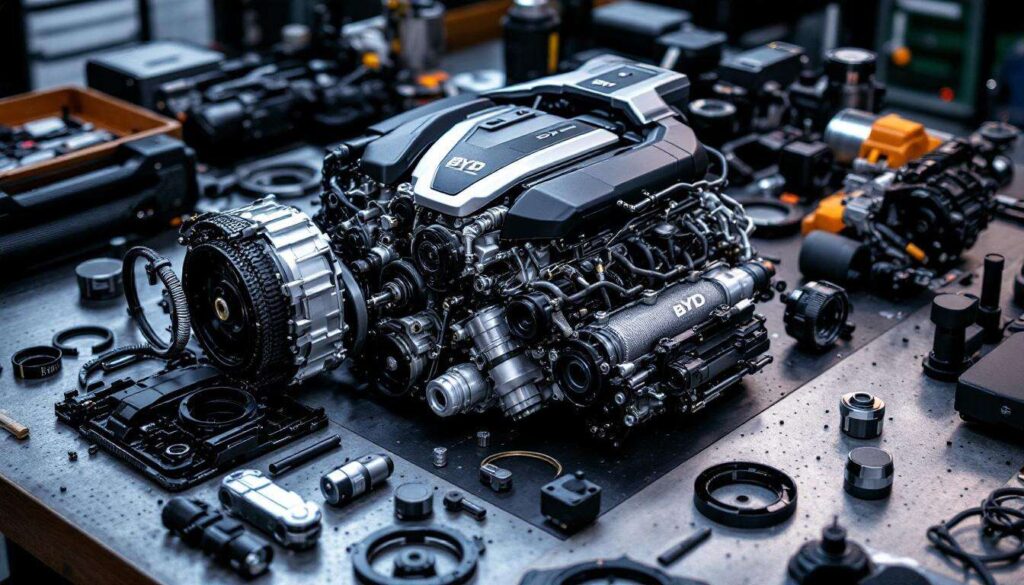
Engineers have recently dismantled a hybrid engine developed by BYD, uncovering sophisticated technological solutions that mirror those employed by premium manufacturers such as Porsche. This teardown has sparked considerable interest within the automotive sector, challenging long-held assumptions about the capabilities of Chinese carmakers and revealing a level of engineering prowess that places BYD alongside established luxury brands. The findings suggest that the gap between mass-market and premium automotive technology is narrowing faster than many industry observers anticipated.
Technological analysis of BYD’s hybrid engine
Compact architecture and optimised gas management
The hybrid engine examined by the engineering team demonstrates a compact architecture that maximises efficiency whilst minimising physical footprint. This design philosophy prioritises optimised gas management, ensuring that combustion processes occur with minimal waste and maximum energy extraction. The engineers noted that the layout reduces friction between moving components, which directly translates to improved fuel economy and enhanced responsiveness during acceleration. Such attention to detail in spatial configuration reflects a maturity in design thinking that was once the exclusive domain of European manufacturers.
High compression ratios and direct injection systems
Among the most striking discoveries were the high compression ratios employed within the engine’s cylinders. These ratios enable more efficient combustion, extracting greater power from each unit of fuel. The direct injection system, finely tuned to deliver precise quantities of fuel at optimal moments, works in concert with these compression ratios to achieve performance levels previously associated with high-end powertrains. The following characteristics were identified:
- Compression ratios exceeding industry averages for hybrid applications
- Multi-stage fuel injection for enhanced combustion control
- Advanced sensor arrays monitoring real-time engine parameters
- Sophisticated engine management software coordinating all subsystems
Flat 2.0T engine configuration
The teardown also revealed details of BYD’s flat 2.0T engine, a pioneering design representing the first production application of a boxer layout in a hybrid vehicle. Developed specifically for the e⁴ platform, this engine configuration offers distinct advantages in terms of vibration reduction and noise suppression. The horizontally opposed cylinder arrangement creates a lower centre of gravity, improving vehicle dynamics whilst simultaneously reducing the harshness typically associated with internal combustion engines. This engine generates a maximum output of 272 horsepower, equivalent to approximately 203 kW, alongside 380 Nm of torque, figures that position it competitively against established rivals.
The dry sump lubrication system incorporated into this design further demonstrates the technical sophistication at play, ensuring consistent oil delivery even under extreme driving conditions. These engineering choices reveal a deliberate strategy to compete not merely on price, but on technical merit and driving refinement.
Comparison with Porsche technology
Shared engineering philosophies
The parallels between BYD’s hybrid engine and technologies employed by Porsche are neither coincidental nor superficial. Both manufacturers prioritise efficiency through precision engineering, employing similar approaches to combustion optimisation, thermal management and power delivery. The direct injection systems, high compression ratios and attention to friction reduction found in BYD’s powertrains echo principles that have long underpinned Porsche’s performance engines. This convergence suggests that fundamental engineering truths transcend brand boundaries and geographical origins.
Comparative performance metrics
When examining performance specifications, the similarities become even more apparent. The following table illustrates key comparative metrics:
| Parameter | BYD Hybrid Engine | Porsche Hybrid Systems |
|---|---|---|
| Compression Ratio | High (specific figures proprietary) | High (optimised for performance) |
| Injection System | Direct, multi-stage | Direct, precision-timed |
| Friction Reduction | Advanced coatings and design | Premium materials and engineering |
| Power Output (2.0T) | 272 hp / 203 kW | Comparable in hybrid applications |
Divergence in application and philosophy
Despite these technical similarities, differences remain in how the technologies are applied. Porsche’s hybrid systems typically emphasise performance enhancement, using electric motors to augment combustion power for sporting applications. BYD’s approach, particularly in the flat 2.0T configuration, focuses on using the combustion engine primarily as a generator for electric propulsion, with mechanical drive capability serving as a secondary function. This reflects differing market priorities and consumer expectations, yet both approaches demonstrate sophisticated understanding of hybrid powertrain optimisation.
Understanding these technical parallels provides essential context for appreciating the broader innovations that BYD has introduced to the automotive landscape.
Technical advances and innovations unveiled
Boxer layout in production hybrids
The implementation of a flat boxer configuration in a production hybrid vehicle represents a genuine breakthrough. Historically, this layout has been employed primarily in sports cars and performance vehicles due to its inherent balance and low centre of gravity. BYD’s adaptation of this architecture for hybrid applications demonstrates innovative thinking, combining the dynamic benefits of the boxer design with the efficiency advantages of electrified powertrains. The reduced vibration and noise levels enhance passenger comfort, whilst the compact vertical profile allows for flexible vehicle packaging.
Integrated electric transmission systems
The engine’s primary role as an electricity generator for the electric transmission system showcases a sophisticated understanding of hybrid powertrain optimisation. Key innovations include:
- Seamless integration between combustion and electric systems
- Intelligent power routing to rear axles when mechanical drive is advantageous
- Optimised operating points maintaining engine efficiency
- Advanced thermal management preventing component degradation
Space efficiency and packaging advantages
The compact dimensions achieved through careful engineering enable vehicle designers to allocate interior space more generously, improving passenger accommodation without increasing overall vehicle size. The dry sump lubrication system contributes to this space efficiency by eliminating the need for a traditional oil pan, allowing the engine to sit lower in the chassis. These packaging advantages translate directly into competitive benefits in markets where interior space and driving dynamics are key purchasing criteria.
These technical advances have significant implications for how the broader automotive market is likely to develop in coming years.
Impact on the automobile market
Shifting competitive dynamics
The revelation of BYD’s engineering capabilities has fundamentally altered perceptions within the automotive industry. Traditional manufacturers, particularly those from Japan and Europe, now face competitors capable of matching or exceeding their technological standards. This competitive pressure is accelerating innovation across the sector, forcing established brands to re-evaluate their development timelines and investment priorities. The days when Chinese manufacturers competed solely on price have clearly ended, replaced by an era where technical sophistication and engineering excellence are becoming defining characteristics.
Pressure on traditional automakers
Japanese manufacturers, long regarded as leaders in hybrid technology, find themselves challenged by newcomers demonstrating comparable or superior engineering solutions. The following competitive pressures are now evident:
- Accelerated development cycles to maintain technological parity
- Increased research and development expenditure
- Strategic partnerships to share development costs
- Re-evaluation of market positioning and brand strategies
Market share implications
As BYD and similar manufacturers demonstrate credible technological capabilities, consumer confidence in their products increases correspondingly. This confidence translates into market share gains, particularly in regions where price sensitivity remains high but quality expectations are rising. The hybrid and electric vehicle segments are experiencing particularly rapid shifts, with newer entrants capturing significant portions of growth markets. Established manufacturers risk losing ground unless they respond decisively to these emerging competitive threats.
Consumer perceptions and responses to these technological developments provide further insight into market dynamics.
Consumers’ reactions and critiques
Changing brand perceptions
The engineering teardown has contributed to a broader shift in how consumers perceive Chinese automotive brands. Where scepticism once prevailed regarding quality and technological sophistication, increasing respect now characterises consumer attitudes. Potential buyers are recognising that BYD and its peers offer genuine alternatives to established brands, combining competitive pricing with credible engineering standards. This perception shift is particularly pronounced among younger consumers less attached to traditional brand loyalties.
Quality and reliability concerns
Despite growing acceptance, some consumers maintain reservations about long-term reliability and durability. Questions persist regarding:
- Longevity of complex hybrid systems over extended ownership periods
- Availability and cost of replacement components
- Service network capabilities and technician training
- Resale values compared to established premium brands
These concerns reflect the reality that brand reputation requires sustained performance over many years, and newer manufacturers must prove themselves through consistent quality delivery.
Value proposition assessments
Many consumers recognise the compelling value proposition offered by BYD’s technologically advanced hybrids. The combination of sophisticated engineering, competitive pricing and comprehensive warranty coverage appeals to pragmatic buyers seeking maximum value. Early adopters report satisfaction with performance, refinement and efficiency, contributing to positive word-of-mouth that further enhances brand credibility. As more consumers experience these vehicles directly, the gap between perception and reality continues to narrow.
Looking ahead, the trajectory established by these technological revelations suggests significant developments for both BYD and the wider automotive industry.
Future prospects for BYD and the industry
Continued technological advancement
BYD’s demonstrated engineering capabilities position the company favourably for future development. Investment in research and development continues at substantial levels, ensuring that the technological momentum established through innovations like the flat 2.0T engine will be maintained and extended. Future powertrains are likely to incorporate even more sophisticated electrification strategies, advanced materials and intelligent control systems, further closing any remaining gaps with premium manufacturers.
Industry-wide transformation
The broader automotive industry faces fundamental transformation driven by competitive pressures from manufacturers like BYD and Tesla. Traditional distinctions between mass-market and premium segments are blurring as technological capabilities become more widely distributed. This democratisation of advanced engineering will benefit consumers through:
- Wider availability of sophisticated hybrid and electric powertrains
- Competitive pricing pressures reducing ownership costs
- Accelerated innovation cycles bringing new technologies to market faster
- Enhanced focus on efficiency and environmental performance across all segments
Regulatory and environmental drivers
Stringent emissions regulations in major markets worldwide will continue driving adoption of hybrid and electric technologies. BYD’s proven capabilities in these areas position the company advantageously as regulatory requirements tighten. The combination of regulatory pressure and technological readiness suggests that manufacturers demonstrating credible electrification solutions will capture disproportionate market growth in coming years.
The engineering teardown revealing BYD’s sophisticated hybrid technology marks a significant moment in automotive history. The discovery of technical solutions mirroring those employed by premium manufacturers like Porsche demonstrates that Chinese automakers have achieved genuine engineering parity in critical areas. The flat 2.0T engine, with its innovative boxer configuration and intelligent integration with electric propulsion systems, represents a technological milestone that challenges traditional assumptions about manufacturing capabilities and brand hierarchies. As competitive pressures intensify and consumer perceptions continue evolving, the automotive landscape is being fundamentally reshaped. Established manufacturers face unprecedented challenges from newcomers capable of competing on technological merit rather than price alone. For consumers, this transformation promises greater choice, improved value and access to sophisticated engineering solutions across broader market segments. The revelations from this teardown suggest that the future of automotive technology will be shaped not by geography or heritage, but by engineering excellence and innovation regardless of origin.